Book Review for Diy Detroit Making Do in a City Without Services
DIY Detroit
Making Exercise in a Metropolis without Services
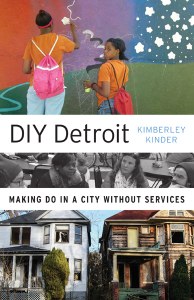
When public services fail, neighbors pace in to keep a metropolis alive
Stuck in a blighted metropolis without basic services such as a bus line, what Detroit's residents are left with afterward decades of disinvestment and refuse is DIY urbanism—sweeping their own streets, maintaining public parks, and boarding up empty buildings. DIY Detroit describes a phenomenon that has get woefully routine as inhabitants of deteriorating cities "domesticate" public services in order to go by.
Kimberley Kinder's DIY Detroit is a clever, beautifully written account of everyday life in the wake of conventional market plummet and decades of austerity. It describes the ways that Detroiters take adapted, frequently defensively, always informally, sometimes illegally, to life without conventional markets and routine municipal services.
—
Jason Hackworth, author of Neoliberal City
For x years James Robertson walked the twenty-1-mile circular-trip from his Detroit dwelling to his factory chore; when his story went viral, it brought him an outpouring of attention and support. But what of Robertson's Detroit neighbors, likewise stuck in a blighted city without services as bones as a bus line? What they're left with, afterward decades of disinvestment and decline, is DIY urbanism—sweeping their own streets, maintaining public parks, planting community gardens, boarding upward empty buildings, fifty-fifty acting equally real estate agents and landlords for abandoned homes. DIY Detroit describes a phenomenon that, in our times of austerity measures and marketplace-based governance, has become woefully routine as inhabitants of deteriorating cities "domesticate" public services in gild to get past. The voices that animate this book humanize Detroit'south troubles—from a middle-class African American civic activist fatigued back by a crisis of conscience; to a young Latina stay-calm mom who has never left the urban center and whose husband works in structure; to a European adult female with a mixed-race adopted family and a passion for social reform, who introduces a chicken coop, goat shed, and market garden into the neighborhood. These people evidence firsthand how living with disinvestment means getting organized to manage public works on a neighborhood scale, helping friends and family members solve logistical issues, and promoting inventiveness, pity, and self-direction as an culling to broken dreams and passive lifestyles. Kimberley Kinder reveals how the efforts of these Detroiters and others similar them create new urban logics and transform the expectations residents take nearly their environments. At the same fourth dimension she cautions confronting romanticizing such acts, which are, after all, short-term solutions to a deep and spreading social injustice that demands comprehensive change.
Kimberley Kinder'southward DIY Detroit is a clever, beautifully written account of everyday life in the wake of conventional market collapse and decades of thrift. It describes the ways that Detroiters have adapted, oftentimes defensively, always informally, sometimes illegally, to life without conventional markets and routine municipal services.
—
Jason Hackworth, writer of Neoliberal Urban center
The book moves easily between personal and neighborhood stories, and big-picture reflections. The thinking is of loftier quality and the prose is readable rather than bookish.
Geographic, ethnographic, and often narratively compelling.
—
Consumption Markets & Culture
DIY Detroit is filled with these simultaneously inspiring and heartbreaking tales of perseverance and innovation. Worthwhile.
DIY Detroit is frankly the Detroit book I have been waiting for. It adds a much-needed perspective to the literatures on urban decay and collective self-provisioning activities.
Ultimately, Kinder has produced a timely and detailed business relationship of how residents are getting by amidst disinvestment. Her ability to bring her characters and neighborhoods alive by elucidating otherwise unremarkable moments and encounters is impressive. DIY Detroit is an eminently accessible text, stemming, in part, from Kinder'due south skill at crafting crisp sentences and her choice to go out citations to the endnotes.
An engaging and informative read, which also makes a compelling argument for the value of qualitative urban enquiry.
A revelation of the creative resilience and routine injustices of everyday life in gimmicky Detroit.
—
Social & Cultural Geography
DIY Detroit is a beautifully written volume. Kinder's account provides important insights into ongoing debates over the future of the so-called comparative gesture in a more than geographically pluralistic urban geography.
ContentsIntroduction: Self-Provisioning in Detroit1. Do-Information technology-Yourself Cities2. Seeking New Neighbors3. Protecting Vacant Homes4. Repurposing Abandonment5. Domesticating Public Works6. Policing Domicile Spaces7. Producing Local KnowledgeConclusion: Triumphs of Hope over ReasonAcknowledgmentsNotesBibliographyIndex
Source: https://www.upress.umn.edu/book-division/books/diy-detroit
0 Response to "Book Review for Diy Detroit Making Do in a City Without Services"
Postar um comentário